|
|
|
|
|
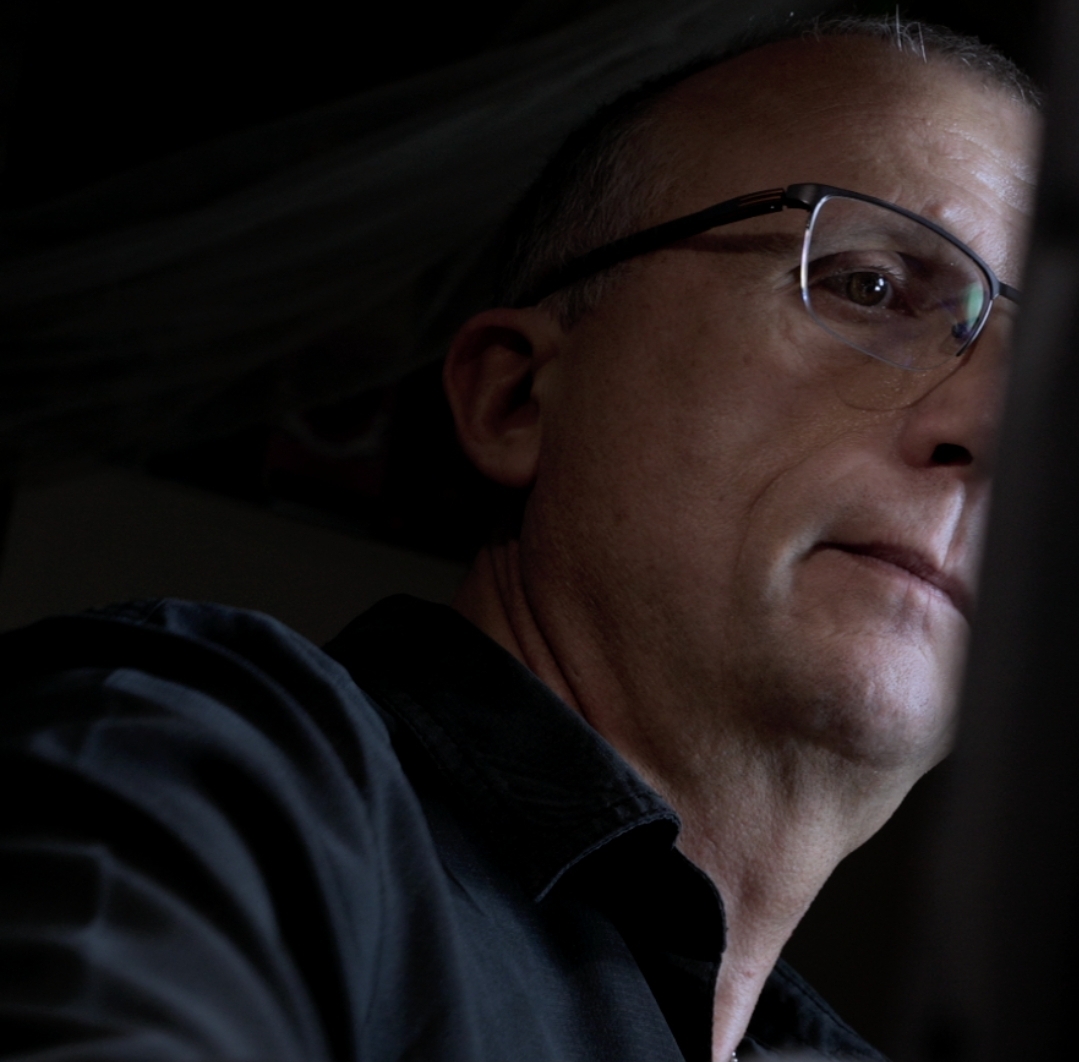
Biography Dominique Meunier (born in 1966) is a painter whose practice is characterized by a plastic and conceptual exploration of liminal territories, situated at the intersection of nature, spirituality, and the intimate. His originality is rooted in a deep technical mastery, inherited from the silkscreen industry and an early artistic education by his mother, a painter and draughtswoman, which enriches the textural and chromatic quality of his canvases. A major biographical event in 2000, an experience on the brink of life, marked a decisive turning point in his work. This "breaching of reality" generated a "collapse of certainties," revealing a transcendent "Light" and a profound sense of unity. From this "fracture of being" arose a "double gaze," capable of simultaneously apprehending the visible and its invisible counterpart, compelling painting to become a new language for expressing the ineffable. This quest, having reached maturity, was revealed to the public in 2018. His work aims to create an immersive visual experience that evokes the presence of the invisible. The intense exploration of Light, treated with a quasi-mystical quality and often emerging from a deliberate shadow, is essential, as is the work of matter which translates the interaction between the tangible and the evanescent. The landscape serves as a reference point, embodying memory and the thresholds where light battling against darkness symbolizes revelation. His paintings, presented as "portals" or "apocalypses" (in the sense of unveilings) towards transcendence and "luminous invisibility," invite the viewer to interpret the mystery of being and the world, engaging them to find a spark of Light in the interstice of their own history. It is a "painting-prayer" in homage to the beauty that surrounds us. His studio, located near Besançon (25), anchors his practice in a deep connection with the natural world, becoming that "alchemical crucible" where lived experience and suffering are transmuted into matter, color, and form. Dominique Meunier's work resonates with major concerns in contemporary art through:
This alchemy between assertive materiality, luminous landscape exploration, and powerful emotional and spiritual charge forges Dominique Meunier's recognizable visual signature. The relevance and strength of this artistic proposition have been recognized by critics and institutions. His work has been presented in France and internationally, rewarded on several occasions, and engages in significant dialogues, such as that with writer and poet Michel Lagrange (laureate of the Académie Française and author known for his collaborations with major artists like Pierre Soulages) for the work "Camera Obscura," highlighting the intellectual and spiritual resonance of his approach. His professional affiliations (Delegate Jura Académie Arts-Sciences-Lettres, Sociétaire du Salon d’Automne, member ADAGP, Fondation Taylor, Maison des Artistes) attest to his solid anchoring in the institutional art landscape. AWARDS 2025 - Bronze Medal (Guest Jury) of the painting prize at the Salon of the National Society of Fine Arts - Paris 2025- Bronze Medal, International Professionals Prize – Mondial Art Academia 2023 - Circle Foundation for the Arts (CFA) Artist of the Year Award 2022 2022- Silver Medal landscape section International Art Academia World Professional Award. 2022 - Special Prize of the Jury at the great competition of the International Academy of Contemporary Art. 2021- Gold Medal International Art Academia World Professional Award "Art Academia World Choice". 2020 - Silver medal (Guest Jury) of the painting prize at the Salon of the National Society of Fine Arts - Paris 2020 - Award winner “Artist of the Future” by Contemporary Art Curator Magazine 2018- Public's first price - group exhibition (80 artists, 300 artworks) LIONS CLUB-Besançon, France Artistic Approach and Major Themes From the Deconstruction of Reality to the Transmutation of BeingThe work of Dominique Meunier rests upon a three-dimensional architecture of thought. This complete system offers the viewer and the reader a method to navigate through trials, a gaze to pierce the invisible, and a purpose to magnify existence. 1. Metaphysical Figuration: The Method (The "How") Metaphysical figuration is the founding act. It does not seek to copy nature, but rather to extract its sacred structure. It is a deconstruction of reality that rejects the immediacy of appearances to explore liminal spaces-those thresholds where matter begins to vibrate. Through his work with mortar and the palette knife, Dominique Meunier kneads chaos. He does not paint a landscape; he builds a stage where shadow and light confront and complement each other. This method allows the figurative landscape to be transformed into a symbolic anchor. The tree, water, or the mountain become archetypes that connect us to a profound existential dimension, finally rendering the invisible visible. 2. The "One-Way Mirror" or the Translucency of the Soul: The Vision (The "Gaze") The concept of the "one-way mirror" defines the state of consciousness required to inhabit the work of Dominique Meunier. It is an invitation to unlearn ordinary vision in order to access a spiritual perception born from hardship. Unlike a classic mirror that traps man within his own reflection (the silvering), Dominique Meunier’s work offers a surface "stripped clean" by life's accident. By removing the layer of narcissism and materiality, it allows us to finally see the essential. The landscape no longer represents nature; it becomes a diaphanous surface. The viewer learns to see through the density of mortar and sand to reach the vibration of the inks. The figurative elements no longer act as a screen; they become purifying filters that clear away the noise of the world. In this interstice between telluric force (immanence) and the clarity of the background (transcendence), the painting becomes a window open to cosmic unity. Here, the landscape is a mirror of the soul. It does not throw back our surface image, but reveals the original Light from which we come, returning us to our true spiritual homeland. 3. The "Vertical Chrysopoeia": The Culmination (The "Purpose") "Vertical Chrysopoeia" is the keystone, the alchemical engine that gives full meaning to the journey. It is the ultimate response to the accident and to pain: the transformation of the lead of suffering into the gold of presence. The alchemy of clay proves that while man is a fragile earth, he is also the only loam capable of becoming Light. The pictorial work—this patient stratification of textures and glazes—mimics the inner work of resilience. The purpose is not mere healing, but an ascension. The totem tree, a true Axis Mundi, symbolizes this elevation of the being who, after touching the depths of the mineral night, decides to rise. Chrysopoeia is this miraculous passage where the roughness of the mortar ultimately radiates a sovereign clarity. By uniting these three pillars, Dominique Meunier converts the fatalism of the Memento Mori into a vibrant Memento Vivere. This system offers the reader a compass: metaphysical figuration provides the tools to confront reality, the "one-way mirror" teaches us to discern the sacred within it, and "vertical chrysopoeia" shows us the path to the Light. It is in this way that the work of Dominique Meunier asserts itself as a liturgy of matter, an invitation to step through the veil of appearances to finally feel the unity and dignity of our condition.
Solo and Themed Exhibitions
Solo exhibition studio, Buthiers, France « Clarity » (2018) ; « Reminiscence and resilience » (2017); « Material and sensations » (2016) ; « The trace » (2015) ; « Song of return » (2014) ; « Path » (2013) ; « Memory and the sea » (2012) ; « Read in oneself » (2011) ; « Blue Addict » (2010) ; « Green Addict » (2008) ; « Crossing to the other bank » (2005) ; « Interval » (2004) ; « Fertile wounds » (2003). Participations in Fairs and Group Exhibitions (selection)
International Exhibitions (selection)
|
|
|
|
|